Throttling Data
BizTalk360 contains a monitoring service specifically to collect the throttling performance counter data from various servers in the environment. The service collects the throttling information of the host/host instances configuration every 15 seconds. The Throttling Analyser feature in BizTalk360 plots them in a graph that will help the user to understand the different states of the host/host instances during a time range. The support users may/may not have sufficient information about the throttling state and the mitigation strategy to reduce the throttling conditions of the host/host instance. This is where Knowledge Base articles can be really helpful for support people to understand the problem and identify a solution.
Let's say the throttling activity of a host instance is being monitored and at a point in time the monitoring service plots the throttling state against the 'System Memory'. Once the reason and a mitigation strategy are identified for the throttling, as a best practice, the information can be documented so that it could be handy for support personnel when they encounter a similar situation.
Adding New KB Article for Throttling Data
- Log in to the BizTalk360
- Click the Knowledge Base icon on the left side panel
- Click Throttling Data and click Add New to create a new KB article
- In the Add New Knowledge Base Article page, enter/select the following information
- Article Title – Give a meaningful name for the article
- Event ID – Add the throttling state value (ex: 4-process memory, 5- system memory, 10 – user override etc.)
- Article Description – Enter the detailed information for the KB Article in the rich text editor provided. The text can be formatted with the appropriate font and size selection, text styling, background colour, alignment control, block quotes, and can use the hyperlink, tables, special characters and print functionality. The text can be updated clearly in more structured way for more readability.
- Environment – Choose the environment in which the KB Article is to be displayed. If the default option (Choose Environment) is chosen, the KB article will be applied to all the environments.
- Computer name – Select the computer name in which the throttling data is being collected.
- Hostname – Select the host for which the throttling information is collected.
- Click Save
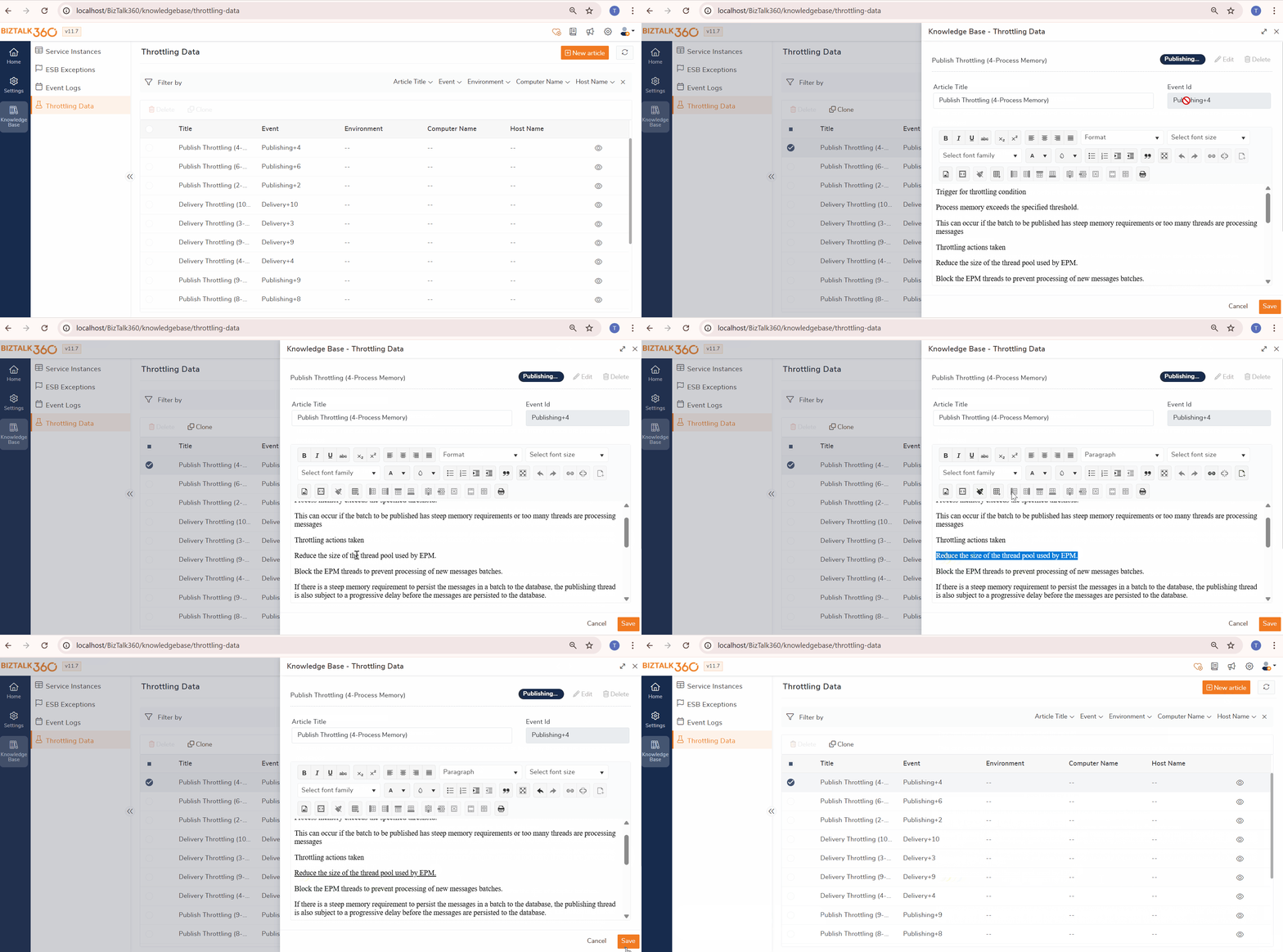
Create multiple articles for the same Throttling data
BizTalk360 allows support persons to create and tag multiple articles against the same error code. The application uses the Best Match scenario to identify and display the KB article for the error code. Let's say there is a KB article for the throttling data "system memory" and a new KB article to be created for the same throttling data, but for a different host as the mitigation steps are different when compared to other host instances. This depends on the additional options, known as tags (Environment, Computer Name, Host Name) that the support person chooses while creating a KB article for the particular service instance error code.
Manage Knowledge Base Articles
Biztalk360 provides options to edit, Delete and Clone knowledge base articles, allowing to maintain and reuse documented knowledge efficiently.
- The edit option allows to modify an existing knowledge base article. Support team can update the article title, description or other mapped details when the resolution steps change or additional information becomes available. Any changes saved will be immediately reflected for future occurrences of the error.
- The Delete option permanently removes the selected Knowledge Base article from the BizTalk360, This is useful when an article is no longer need, incorrect or when its duplicated. A confirmation popup will be displayed to prevent accidental deletion.
- The Clone option allows to create a copy of an existing knowledge Base article. This is particularly useful when creating multiple articles for the same error code with slight changes. The cloned article retains all the original details which can be edited as required before saving.
These options help ensure that Knowledge Base articles remain accurate and reusable.