If the SQL transaction log file is consuming a significant amount of disk space, follow the steps below to identify the cause and reduce the log file size where appropriate.
Check Disk Usage
First, check how much disk space is being used by the transaction log file.
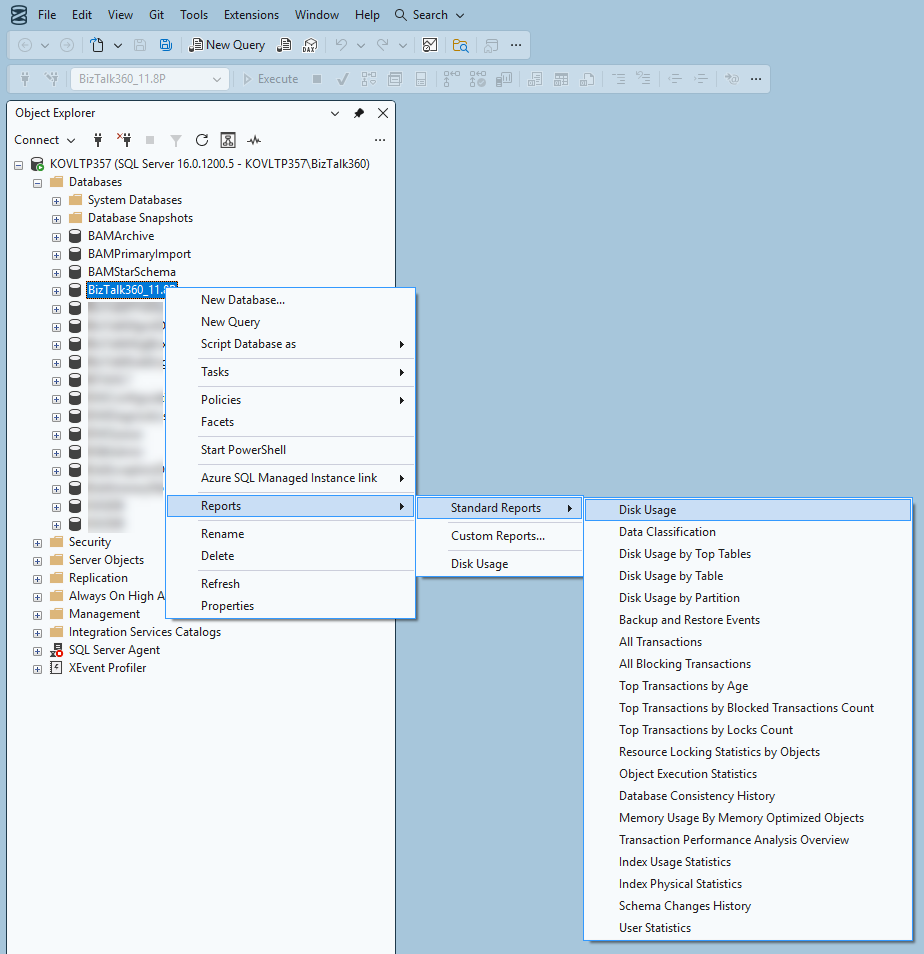
In SQL Server Management Studio (SSMS), right-click the BizTalk360 database.
Select Reports → Standard Reports → Disk Usage.
Check the transaction log space usage. If a significant percentage of the log file is unused, you can shrink the log file to release the unallocated space.
Shrink the Transaction Log File
To release unused space from the transaction log file:
Open SQL Server Management Studio (SSMS).
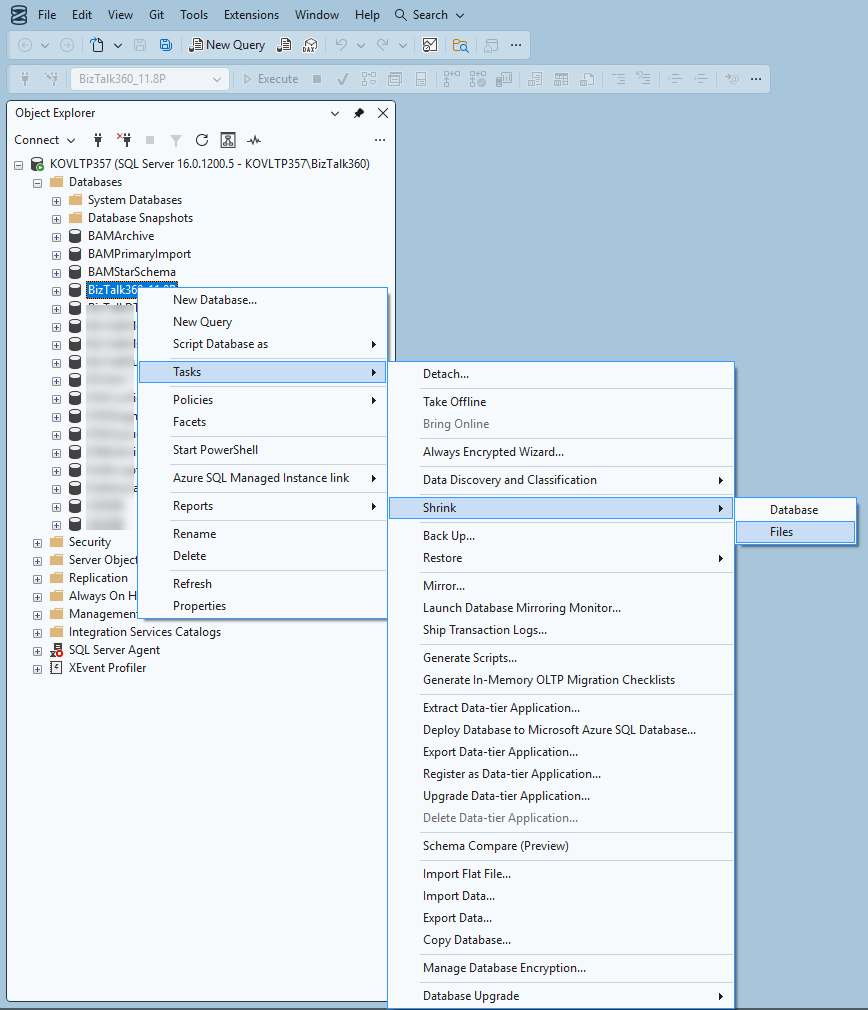
Right-click the BizTalk360 database.
Select Tasks → Shrink → Files
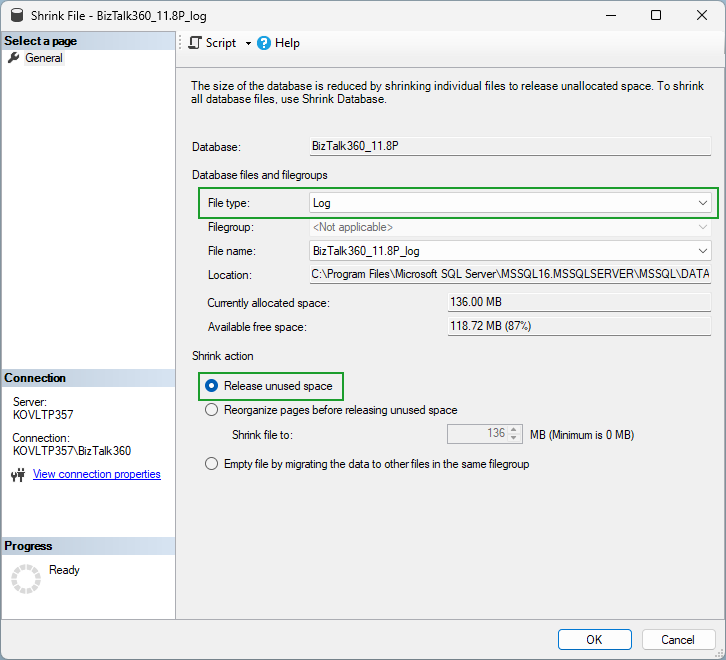
Select the appropriate File type and File name.
Select Release unused space.
Click OK.
The Release unused space option releases unallocated space back to the operating system without moving data within the file.
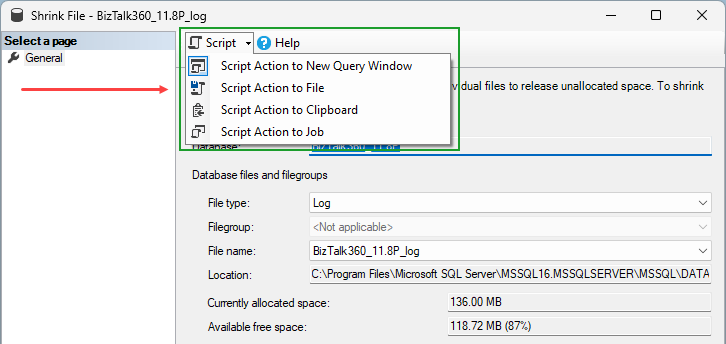
You can also create and execute a SQL script to shrink the transaction log file.
Shrinking a transaction log file does not resolve the underlying cause of continuous log growth. Avoid shrinking the log file repeatedly as a routine maintenance activity. Instead, identify why the log space cannot be reused and address the underlying issue.
Troubleshoot a Transaction Log That Cannot Be Truncated
If the transaction log file remains large after shrink, the database may be waiting for a transaction log backup or another operation before it can reuse the log space. This commonly occurs when the database uses the FULL or BULK_LOGGED recovery model and does not perform regular transaction log backups.
Check the Log Reuse Wait Reason
Execute the following query in SSMS:
SELECT name, recovery_model_desc, log_reuse_wait_desc
FROM sys.databases
WHERE name = 'BizTalk360';
Review the log_reuse_wait_desc column to identify why SQL Server cannot reuse the transaction log space.
If the result isLOG_BACKUP, a transaction log backup is required before the log space can be reused.
Take a Transaction Log Backup
If the database uses the FULL or BULK_LOGGED recovery model, and the log reuse wait reason is LOG_BACKUPtake a transaction log backup to a suitable backup destination.
For example:
BACKUP LOG [BizTalk360]
TO DISK = N'D:\SQLBackups\BizTalk360_Log.trn'
WITH COMPRESSION;
Replace the example destination with an appropriate path that exists on the SQL Server and is accessible to the SQL Server service account. After the backup completes successfully, check the log reuse wait reason again:
SELECT log_reuse_wait_desc
FROM sys.databases
WHERE name = 'BizTalk360';
If the log space is now reusable, you can attempt to shrink the log file to an appropriate size.
Note: The
BACKUP LOG ... WITH NO_LOGcommand shown in older SQL Server (2008 SQL) guidance is no longer supported. Do not use it.
Consider the Recovery Model
If the database uses the SIMPLE recovery model, SQL Server automatically reclaims inactive transaction log space when possible. However, active transactions or other conditions can still prevent log space reuse.
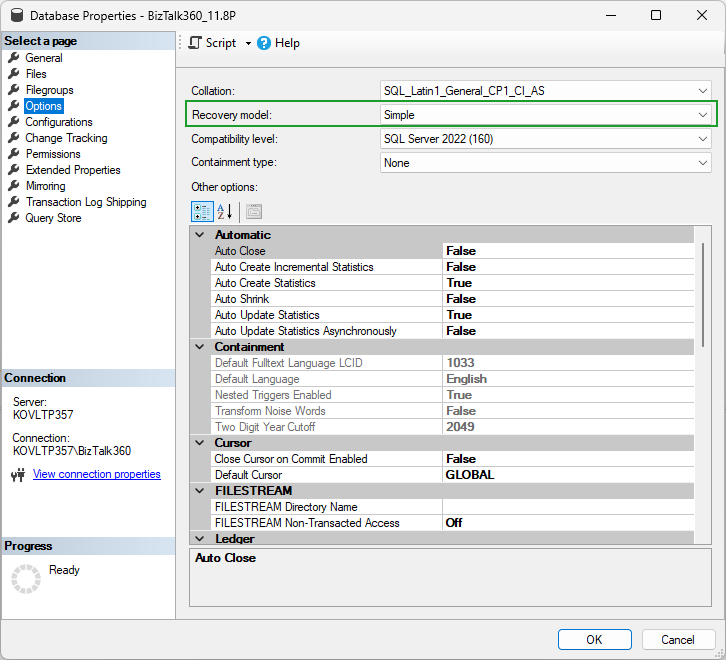
Switching from FULL to SIMPLE recovery should not be treated as a routine log-shrinking solution. It breaks the existing transaction log backup chain and affects point-in-time recovery. Before changing the recovery model, review your backup and recovery requirements with your database administrator.
Clean Up the BizTalk360 Database in an Availability Group
If the BizTalk360 database is part of a SQL Server Always On Availability Group, additional considerations apply.
Do not remove the database from the Availability Group or switch it to SIMPLE recovery solely to shrink the transaction log.
A large transaction log can often be addressed by taking the required transaction log backups and resolving the underlying log reuse issue without disrupting high availability.
If database maintenance genuinely requires removing the database from the Availability Group, plan the operation with your SQL Server administrator and follow the appropriate procedure for your SQL Server version and topology. A planned maintenance procedure may include the following steps:
Review the Availability Group configuration, backup strategy, and recovery requirements.
Take the required database and transaction log backups.
Remove the database from the Availability Group only if necessary and in accordance with the approved maintenance plan.
Perform the required database maintenance.
Change the recovery model to SIMPLE. If the recovery model is changed to SIMPLE, understand that the existing transaction log backup chain is broken. Take a new full backup before establishing a new log backup chain.
Run the cleaning job to shrink and clear the database
Prepare the secondary replica for rejoining the Availability Group using the supported seeding or database restoration procedure.
Rejoin the database to the Availability Group and verify synchronization and data movement.
Confirm that the transaction log backup schedule and database monitoring are operating correctly.
The exact steps depend on the Availability Group configuration and whether automatic or manual seeding is used. Follow the appropriate Microsoft documentation for your environment.
Summary
To manage the BizTalk360 transaction log file size effectively:
Check the database's disk usage and transaction log space consumption.
Check
log_reuse_wait_descto identify why log space cannot be reused.Take transaction log backups when required by the recovery model.
Shrink the log file only when necessary and after resolving the underlying issue.
Avoid switching recovery models or removing a database from an Availability Group without evaluating the impact on backup recovery and high availability.
Configure regular database backups and monitor transaction log growth to prevent recurring disk space issues.